Reports on Plant Diseases |
| RPD No. 103 -
Scab of Cereals |
April
1996 |
[ Symptoms
] [ Disease Cycle ][ Control
]
| Scab – also known as head blight, pink mold, or white-heads –
is caused by several fungi in the genus Fusarium. The principal
pathogens are Fusarium graminearum, F. avenaceum,
and F. culmorum (synonymous name for all three is F.
roseum f. sp. cerealis) and F. nivale.
These fungi produce only asexual spores with limited genetic diversity.
The sexual stage is known as Gibberella zeae.
Scab infects all small-grain cereal crops, corn, and many other grasses
including spelt, emmer, cheat, wildrye, several foxtails, quackgrass,
crabgrass, and bluegrasses. Other plants that may be attacked include
clovers, alfalfa, pokeweed, sweet potato, and several members of the parsley
family. In Illinois, the fungi that cause scab and related diseases are
most widespread and damaging on wheat, barley, rye, and corn. Scab can
be severe in wheat sown in residue from a previous host crop such as corn.
The Fusarium fungi may cause a blast of the spikelets (usually
called head blight or scab), a rot of the root, crown or foot, and stem
blight. The fungi also cause a seedling blight and a rot of the stalk,
root and the ears on corn. The stand, yield, quality, and feeding value
of the grain may all be seriously affected by scab. The disease has been
reported from most of the humid and semihumid areas of the world where
cereals and corn are grown. The severity of scab infection on cereal grains
varies greatly from year to year. Severe infection occurs during the flowering
stage and shortly afterward, when the weather is warm and moist. If the
weather is dry after the head emerges, small grains will be nearly scab-free.
Symptoms
SCAB OR HEAD BLIGHT
In the field, the earliest and most conspicuous symptom of scab infection
occurs soon after flowering. Diseased wheat spikelets become a bleached,
light-straw color and ripen prematurely, while healthy spikelets are still
a normal green. Diseased wheat kernels are grayish brown and lightweight.
Scab-infected rye kernels are dark brown to carmine-red. If the entire
head is infected, barley spikes are dwarfed; diseased spikelets are compressed
rather than spreading. Scab-infected spikelets of oats are ash-gray; those
of barley, light brown. One or more spikelets may be infected, or the
entire head may appear prematurely bleached (Figure 1). The dead 'whiteheads,'
which are sterile or contain only partially filled seed, are often rapidly
colonized by secondary black molds.
During warm and moist weather, masses of light-pink to salmon-colored
mold (composed of mycelium and "summer" spores or conidia of
the fungi) may form on infected glumes and lemmas of the spikelets, especially
near the base of the kernel. This is an excellent diagnostic sign. Infected
kernels are generally shrunken, wrinkled, and light in weight, with a
rough and flaky-to-scabby appearance (Figure 2). These kernels range in
color from light brown to pink or grayish white, depending on the time
of infection and the weather conditions.
Occasionally, the fungus may girdle and kill the spike or rachis of a
grain head, causing the parts beyond to die. The result is no grain at
all or small, shriveled kernels that are separated-out in the process
of harvesting or threshing. If the weather remains warm and moist, spikelets
on heads infected early become speckled by harvest time with superficial,
spore-producing bodies (perithecia) that are a dark purplish black (Figure
3).
|
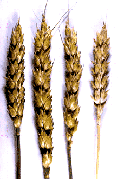
Figure 1.
Left, healthy; and right, three scab-infected wheat heads.
|
|

Figure 2.
Three scab-infected wheat kernels are shown on the right, with three normal
kernels on the left.
|
SEEDLING BLIGHT, ROOT ROT, FOOT AND CROWN ROT
Infected seedlings may be killed before or after emergence. The seedlings
that emerge are stunted, turn yellow and die. The roots and hypocotyl
(length of stem between the lowest node and the root) are water-soaked,
light brown to reddish brown, and may be covered with a mass of pink or
grayish mold. Severely blighted seedlings die. The infected seedlings
that survive lack vigor, tiller poorly, and frequently send up a single
stem on which a small head is produced. A light brown, reddish brown,
or grayish brown rot of the crown and foot may occur as the weakened plants
approach maturity. Fusarium nivale is favored by low soil temperatures
while other Fusarium species are favored by higher temperatures.
Poor stands are common from sowing scab-infected seed. Scabby kernels
are often dead, or else germinate weakly. If a sprout manages to emerge
from the soil, it frequently decays before it can become established.
STEM BLIGHT
This occurs as a cereal grain approaches maturity. The worst attacks occur
on crops on heavy wet soils. Affected plants die early or ripen prematurely,
showing a bleached, yellowish appearance. The fungi commonly attack the
culms at the 'joints' (nodes), causing a girdling and the death of the parts
above the joints. Such plants lodge easily during rain and wind storms.
The fungus responsible for stem blight can often be seen as pinkish white,
pinhead-sized pustules on the lower nodes of infected plants. |
|
The scab fungi overseason and propagate in and on the soil as spores,
mycelium (threadlike mold growth), and fruiting structures known as perithecia
which produce ascospores. Light pink to orange-colored masses of conidia
or "summer" spores are produced in tremendous numbers during
warm, moist weather. Ascospores (often called "winter" spores)
produced within the perithecia are discharged into the air during warm,
moist weather in the spring and early summer. Air currents and rainsplash
carry the ascospores and conidia to the young spikelets. The spores germinate
in a film of moisture and first invade the flower parts, frequently spreading
to the glumes and other parts of the head. Infections are most frequent
and serious at anthesis. At this time, anthers and pollen may serve as
a food base for pathogens. Blight symptoms develop within 3 days after
infection, when temperatures range between 77 and 86 F and moisture is
continuous. In areas that otherwise are too dry for scab development,
sprinkler irrigation may predispose plants to the disease.
Conidia and ascospores may also fall on crop residues. These spores soon
germinate, resulting in mycelium which produces large numbers of conidia.
Both the ascospores and conidia are capable of producing infection if
they land on the head of a cereal or grass plant during or shortly after
the blossoming period. Within 7 to 10 days after infection, salmon-pink
masses of conidia form at the base of the diseased spikelets. These conidia
are carried by the wind to the heads of other cereal and grass plants
in turn producing new, secondary infections. The process is repeated as
long as the spikelets are susceptible and the moist weather prevails.
Secondary infections may result from the long-distance spread of airborne
conidia. Ascospores are usually produced too late in the season to function
as secondary inoculum, but persist in crop residue and will contaminate
seed.
Seedling infections result primarily from seedborne mycelium and spores.
When the soil temperature is above 60 , seedlings from clean seed may
become infected from mycelium in decaying crop residues on or in the soil.
Head and stem infections occur independently of seedling blight and root
rot, since the fungi cannot grow for any distance within the cereal plant.
However, the fungi may live for several years within infected kernels.
TOXICITY OF SCABBY GRAIN
The growth of the Fusarium fungi in scabbed grain produces
toxic compounds (mycotoxins) that cause muscle spasms, acute vomiting,
nausea, dizziness, diarrhea, and soreness in man, young chickens and ducklings,
pigs, dogs, horses, and other nonruminant animals with simple stomachs.
In swine feed, 3 percent or more of scabby grain cause vomiting, and then
the swine refuse to eat the mixture. Cattle, sheep, and mature poultry
(except pigeons) do NOT react to scabbed grain. Because one of the mycotoxins
involved has some estrogenic activity, scabby grain should not be fed
to breeding animals. The mycotoxins apparently remain stable for years
in stored grain. Bread made from scabby grain has been described as 'intoxicating.'
Heavily scabbed wheat kernels are generally very lightweight and easily
removed by modern cleaning equipment. However, scabbed barley and oat
kernels are much more difficult to remove from healthy grain.
Back to Top
|
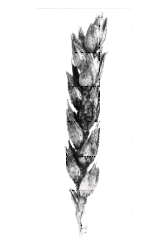
Figure 3. Wheat
head covered with perithecia of Gibberella zeae.
|
- Rotate small grains and corn with legumes, allowing at least a one-year
break in cereal, grass, or corn cultivation. Plant small grains as far
as possible from old cornfields.
- Sow only plump, small-grain seed that has been thoroughly cleaned
to eliminate all lightweight seed and then treated with a protective,
broad spectrum fungicide or fungicide mixture. Proper seed treatment
controls seedling damage from infected seed, but will NOT control the
head blight or scab, foot rot, and stem blight phases of the disease.
- Sow adapted and recommended small-grain varieties in a fertile, well-prepared
seedbed.
- Delay the sowing of winter cereal grains until the temperature is
60 F or below, to reduce the chances of severe seedling blight. Sowing
spring cereal grains early tends to reduce losses from seedling blight,
crown rot, and head blight.
- Where feasible, plow under cleanly and deeply all infected stubble
debris and straw of small grains and weed grasses, cornstalks, and rotted
ears. Complete coverage of crop residues helps reduce head blight infections.
Sanitation is most effective when it is done on a community-wide basis.
Manure containing infected straw or cornstalks should not be used for
top dressing.
- No highly resistant varieties of wheat, oats, barley, or rye are
available. Some varieties are infected less frequently, apparently because
of physical barriers to the infection of florets and spikelets. Not
all differences in the incidence of head blight among wheat or barley
varieties growing in adjacent fields are genetically based. The time
of anthesis and prevailing weather conditions at flowering can also
influence the development of scab.
- Store grain at a moisture level of <14% to prevent the growth of
the fungus and the possible production of additional mycotoxins.
Back to Top
|
For further information concerning diseases of crucifers
and other vegetables, contact Mohammad Babadoost, Extension Specialist in Fruit
and Vegetable Pathology, Department of Crop Sciences, University of Illinois
at Urbana-Champaign.
University of Illinois Extension provides equal
opportunities in programs and employment.
|


