Reports on Plant Diseases |
| RPD No. 1001
- Seed Treatments for Field Crops |
July
1990 |
|
Fungicide seed treatment is inexpensive insurance against a number of
diseases that impair stands, reduce yields, and lower grain quality. Seed
treatment is especially valuable during cold, wet weather or very dry
weather in protecting germinating seed and young seedlings against seed-
and soilborne fungi that cause seed decay and seedling blights (damping-off).
For example, proper seed treatment controls certain smut fungi that infect
the seed and young seedlings of cereals and forage grasses (Figure 1).
Fungicide seed treatment also is effective in controlling seedborne fungi
that cause the seedling stage of scab on small grains and grasses (Figure
2), anthracnose, seedborne root and crown (foot) rots, "Helminthosporium"
stripe and net blotch of barley, spot blotch of small grains, and various
seedborne fungi that cause leaf spots and blotches (Figure 3). Seed treatments
also reduce losses from soilborne fungi which infect germinating seeds
and young seedlings of soybeans. Several fungi, including Pythium, Phytophthora
and Rhizoctonia, can significantly reduce seedling stands and vigor when
weather conditions do not favor rapid germination and emergence. Fungicide
seed treatments are also effective in controlling seedborne pathogens
that can reduce germination to unacceptable levels.
|
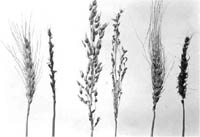
Figure 1.
Crown gall of rose.
|
|
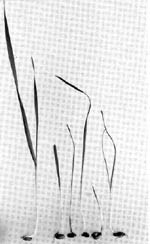
Figure 2.
Crown gall of rose.
|
Seed should always be cleaned before applying seed treatments. Thorough
cleaning removes weed seeds, smut "balls" and particles, bits
of chaff and straw, and lightweight kernels or seeds that may be infected,
as well as other undesirable impurities. Although seed can be treated
on the farm at the time of planting, it is best to have treatments applied
by elevators, seed and feed houses, or processing plants to insure thorough
coverage.
Seeds are treated by fungicides formulated as dusts, wettable powders,
dry or liquid flowables, or liquids. The fungicide may be applied to seed
on the farm as dusts or liquids (slurries) by using a revolving barrel
or oil-drum treater or by adding it to the drill or planter box. Manual
mixing with the seed in the drill box immediately before sowing reduces
the possibility of treated grain being used for animal feed or human consumption.
To ensure thorough mixing, apply half the required amount of fungicide
to the half-filled drill box, stir the grain well with a paddle, (do not
use your hands!), then add the remaining seed and fungicide and stir again.
Wettable powders and dry flowables are usually applied to seed in a commercial
slurry machine. Liquids and liquid flowables are commonly applied in various
commercial, ready-mix, mist-type, or slurry-type treaters. Fungicides
should be applied to seed as close to the time of planting as possible.
|
|
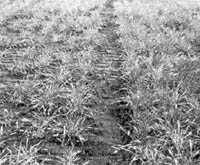
Figure 3.
Cottonwood crown gall. Tumors may appear several feet above ground (photo,
J.C. Carter)
|
The full benefits from seed treatment are not obtained unless combined
with additional disease-control measures including: (1) planting disease-free
seed, (2) rotation with nonrelated crops, (3) clean and deep plowdown
of crop residue about every third year or when disease losses have been
serious, if this is compatible with controlling soil erosion, and (4)
planting at the proper time, depth, and spacing using locally adapted
and resistant varieties and hybrids whenever possible.
Before treating, read and follow all the manufacturer's directions on
the container label. Do NOT use treated seed for food, feed, or oil purposes,
even after it has been stored for months or years.
Fungicides registered by the federal EPA for seed treatment on field
crops are listed in University of Illinois Agricultural Pest Management
Handbook, which is revised annually. This circular is available at your
nearest Extension office or ITCS, P345 University of Illinois, 1917 S.
Wright St., Champaign, IL 61820.
|
Back to Top
For further information concerning diseases of crucifers
and other vegetables, contact Mohammad Babadoost, Extension Specialist in Fruit
and Vegetable Pathology, Department of Crop Sciences, University of Illinois
at Urbana-Champaign.
University of Illinois Extension provides equal
opportunities in programs and employment.
|


