Reports on Plant Diseases |
RPD No. 201 - Stewart's Leaf Blight of Dent Corn
| December 1995 |
[ Symptoms ] [ Disease
Cycle ] [ Disease Forecasting ] [ Control
]
| Stewart's leaf blight, or Stewart's bacterial wilt of corn, is caused
by the bacterium Erwinia stewartii. This bacterium causes a similar but
more serious disease of sweet corn. Wilt symptoms seldom develop on dent corn,
even under conditions that are ideal for disease development. Seedlings of very
susceptible hybrids may wither and die. Stewart's leaf blight is found each year
on dent corn in localized areas of Illinois, especially in the southern third
to southern half of the state. Infection that is severe enough to cause yield
reduction occurs most often in south-central Illinois, when susceptible hybrids
are grown. Severely blighted plants almost always show a marked increase in stalk
rot. The severity of Stewart's leaf blight is increased by high temperatures. |

Figure 1.
Stewart's leaf blight on dent corn leaves.
|
|
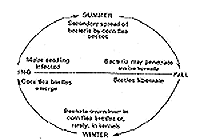
Figure 2.
Disease cycle of the Stewart's leaf blight bacterium.
|
SymptomsStewart's leaf blight is characterized
by short-to-long, irregular leaf streaks (Figure 1). The first infections generally
appear after tasseling. Initially, the streaks are pale green to yellow; later,
the tissues die and change to a tan or straw color. Individual streaks may extend
along the length of the leaf with irregular wavy margins that tend to follow the
leaf veins. Several streaks may merge, causing the entire leaf to wither and dry.
If leaves die prematurely, yields are reduced and the weakened plants become more
susceptible to stalk rot. Examination of the streaks, especially when the leaf
is held up to the light, will show feeding marks made by the corn flea beetle
(Figure 5). The marks appear as fine scratches that are white, irregular, and
usually at a right angle to the streak. Infected plants may produce bleached and
dead tassels. Brown to black cavities may form in the stalk pith of severely infected
plants near the soil line (Figure 4). Some bacteria may spread into the kernel
of extremely susceptible hybrids. Seed transmission is at a very low rate even
in the most susceptible hybrids.
| Back
to Top
|
The bacterium overwinters
almost exclusively within the body of the adult corn flea beetle (Chaetocnema
pulicaria) (Figure 3). Adult beetles begin to feed on corn seedlings in late
spring to early summer. The beetles spread the bacterium to corn plants through
their feeding wounds. Flea beetles continue to spread the causal organism throughout
the growing season by feeding on infected plants, then flying and feeding on healthy
ones. In areas where Stewart's leaf blight or bacterial wilt was severe during
the previous growing season, an average of 20 percent of the beetles coming out
of hibernation in the spring are contaminated with the bacterium. The flea beetles
may be carried by air currents for 20 miles or more. Flea beetles feeding on diseased
corn plants become contaminated and carry the bacterium to healthy plants. As
the season progresses, new broods of corn flea beetles become infected, greatly
increasing the number of contaminated beetles. The beetles carry and transmit
the bacterium as long as they live. Other host plants for the Stewart's
leaf blight bacterium include eastern gamagrass (Tripsacum dactyloides)
and teosinte (Zea mays subsp. mexicana). The importance of these
hosts in the disease cycle is unknown. |

Figure 3.
An adult corn flea beetle. The actual length of the insect is 1/16th of
an inch.
|
Disease Forecasting Low
winter temperatures limit beetle survival. For this reason, damage is unlikely
when the mean temperature (fahrenheit) for the preceding December, January, and
February is below 27 F.
Severe damage is likely if the mean is above 33
F, especially during two consecutive winters. Intermediate damage usually occurs
if the average is between 27 and 33 F.
|
If the index* is
|
Early season wilt probably will be
|
Late-season leaf blight probably will be
|
| Below 27 |
Absent, or nearly so
|
A trace, at most
|
| Between 27 and 28 |
Absent to light
|
Light
|
| Between 28 and 30 |
Light
|
Light
|
| Between 30 and 33 |
Light
|
Moderate to severe
|
| 33 or more |
Destructive
|
Severe
|
*Mean temperatures ( F) for the preceding December, January, and February.
|
Because of low winter temperatures, flea beetles seldom survive in the
northern half of Illinois. Those found in the late spring or summer have
been carried by southerly winds. Prolonged periods of wet summer weather
are unfavorable for beetle multiplication and feeding. Dry weather is
favorable.
The causal bacterium may survive for several months in seed and corn
stalk residue; however, the number of plants that become infected from
such sources is considered insignificant. Sporadic outbreaks in Latin
America, Europe, the USSR, and China are probably caused by planting infected
seed.
|
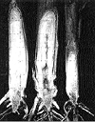
Figure
4. Dark cavities in stalk pith, caused by Stewart's leaf blight bacterium.
|
|
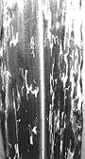
Figure
5. Feeding scratches made by corn flea beetles. (Dr. R.R. Bergquist).
|
The adults and larvae of the 12-spotted cucumber beetle (Diabrotica
undecimpunctata howardi) and toothed flea beetle (Chaetocnema denticulata),
and the larvae of the seed corn maggot (Hylaemya cilicrura), the
northern corn rootworm (D. Longicornis), the western corn rootworm
(D. Virgifera), wheat wireworm (Agriotes mancus), and white
grub (Phyllophaga sp.) are suspected of carrying the wilt bacteria
infrequently from one corn plant to another during the summer. Corn plants
become infected at temperatures of 60 to 95 F (15 to 35 F). The bacteria
multiply rapidly inside the plant and may plug the water-conducting vessels,
producing typical symptoms of leaf streak and wilt. If conditions are
favorable for infection, symptoms begin to appear in one or two weeks,
but may not develop until the plant is nearly mature.
|
Back to Top
- Grow resistant,
dent corn hybrids in the southern third or southern half of Illinois. Hybrids
that are resistant to northern corn leaf blight also tend to be resistant to Stewart's
leaf blight.
- Maintain mineral nutrition, since that
influences the susceptibility of corn hybrids to infection. High levels of ammonium
nitrogen and ph osphorus increase susceptibility whereas high levels of calcium
and potassium tend to decrease susceptibility to infection.
- Use
a recommended insecticide in the furrow to control corn flea beetles. This is
only suggested for sweet and pop corn. Use of an insecticide is not economically
feasible and not recommended for dent corn. One to six sprays of a suggested insecticide,
spaced three to five days apart, may be required to protect susceptible sweet
corn cultivars. The first application should be made on the day before
the corn emerges. Follow current recommendations of Extension Entomologists at
the University of Illinois at Urbana-Champaign and your nearest Extension adviser.
Back
to Top
For further information concerning
diseases of crucifers and other vegetables, contact Mohammad Babadoost, Extension
Specialist in Fruit and Vegetable Diseases, Department of Crop Sciences, University
of Illinois at Urbana-Champaign. University
of Illinois Extension provides equal opportunities in programs and employment. |


