integrated pest management
Educational MaterialsFrequently Asked QuestionsVideoDecision Aids

Field CropsFruitsVegetablesLandscape & TurfGreenhouseHome, Yard & GardenLivestock

Reports on Plant Diseases

RPD No. 211 - Viral Diseases of Corn in Illinois

May 1993


[ Maize Dwarf Mosaic ] [ Wheat Streak Mosaic ] [ Control ]


More than 25 viruses are known to infect corn. So far, only 4 viruses have caused natural infections of the corn crop in Illinois—those causing maize dwarf mosaic (MDM), sugarcane mosaic (SCM, formerly MDM strain B), maize dwarf mosaic (MDM), wheat streak mosaic (WSM), and maize chlorotic dwarf (MCD). Until 1977, the occurrence of those viruses was limited to areas where alternate hosts were prevalent. The most important alternate hosts are Johnsongrass for MDM and MCD and wheat for WSM. In 1977 and 1978, however, SCM was prevalent in northern Illinois where no Johnsongrass is found. Other annual or perennial grasses may be serving as reservoirs for the SCM virus, or aphids carrying SCM may blow in from southern regions.

Identifying viral diseases of corn in the field is difficult. The similarity of symptoms, occurrence of two or more viruses in the same locality, existence of viral strains, and inadequate diagnostic aids are some of the factors that lead to confusion in diagnosis. In addition, several symptoms of viral infection can be confused with genetic or mineral-deficiency abnormalities. The possibility of genetic and nutritional disorders may be eliminated by (1) transmission from diseased to healthy indicator plants, (2) serological studies to detect the presence of a known plant virus, and (3) an examination of diseased tissue by electron microscopy to check for viral particles and virus induced abnormalities in the plant cells.


Figure 1. Maize dwarf mosaic. (Courtesy D.G. White)

Figure 2. Electron micrograph of the long, flexuous rods associated with both maize dwarf mosaic and sugarcane mosaic. The virus particles, about 750 nm in length, are shadowed with palladium
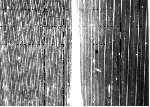
Figure 3. Symptoms of maize chlorotic dwarf on a young corn leaf (R); healthy leaf (L).


Maize Dwarf Mosaic

Maize dwarf mosaic (MDM) was discovered in corn in the Midwest during 1962. It is widely distributed in bottomland fields that are close to rivers and other bodies of water. MDM is usually most serious where Johnsongrass is a common weed. The disease often reappears in the same fields or general area in succeeding years. Many fields will show only a trace of light infection one year, but will be severely damaged during following years. Sugarcane mosaic (SCM) was described in sugarcane in the South in the early 1900's but it was not known to occur commonly or cause problems in corn. Sweet corn is more susceptible than dent corn.

The symptoms of MDM and SCM occur first in the youngest leaves as an irregular, light- or dark-green mosaic or mottle that may develop into narrow, light-green or yellowish streaks along the veins (Figure 1). The mosaic or mottle often appears as dark green areas on a yellowish or chlorotic background. Early infection, before the fourth or fifth leaf stage, may cause moderate to severe stunting, a "bushiness" of the plant, and poor seed set. In sweet corn, a lack of kernels at the butt end of the ears is common. As infected plants grow and the temperatures rise, the mosaic often fades and young leaves become more yellow. Plants infected by viruses early are predisposed to infections by fungi resulting in stalk and ear rots.

Only mild symptoms develop in corn plants when they become infected after the ear formation is advanced. The typical mosaic pattern is often seen most clearly on the youngest leaves. Plants that are infected late usually grow and produce normally.

The MDM and SCM virus particles are long, flexuous rods about 750 nanometers in length (Figure 2). The virus is transmitted mechanically and also by at least 20 species of aphids. The aphids can acquire the virus by feeding on infected Johnsongrass plants or other infected grasses in the spring and summer. Transmission occurs when the virus-carrying aphids migrate into corn fields and start to feed.

Several strains of both MDM and SCM viruses have been given letter designations. In Illinois, strain A (MDMV-A) and strain MB (SCMV-MB) have been identified. MDMV-A overwinters in Johnsongrass tubers; SCMV-MB does not infect Johnsongrass.

Besides all types of corn and Johnsongrass, over 100 wild and cultivated grasses are infected by these viruses. These include sorghums, Sudangrass, sorghum-Sudangrass hybrids, several bristle grasses, cup grass, little bluestem and lovegrass, Indian grass, a number of foxtails, barnyard grass, large crabgrass, downy bromegrass or cheat, Japanese chess, goosegrass, as well as other Setaria, Panicum, and Bromus species. Some of these hosts show no visible symptoms when infected, especially in hot weather. None of the small grains, the useful pasture-forage grasses (timothy, redtop, orchardgrass, smooth bromegrass, bluegrasses, fescues, wild rye, ryegrasses, and reed canarygrass), or such common weeds as quakegrass and bullgrass, are known to become infected.

Back to Top

Maize Chlorotic Dwarf

The disease called maize chlorotic dwarf (MCD) was discovered in the Midwest in 1972 and in Illinois in 1973. The symptoms of MCD include a stunting of the plants and the appearance of chlorotic leaf margins and chlorotic streaks in the leaf veins (Figure 3). A reddening of the leaves is also common. The virus is not transmitted mechanically, but it is spread from plant to plant by the leafhopper Graminella nigrifrons in a semi-persistent manner. The MCD virus is acquired by the leafhoppers from Johnsongrass and is transmitted to corn as the insects feed. The spherical virus particles are about 28 nanometers in diameter (Figure 4).

Maize chlorotic dwarf is found in areas where Johnsongrass grows. Relatively little is known about the virus, its host range and its complete distribution.

Back to Top

Figure 4. Electron micrograph of negatively stained maize chlorotic dwarf virus particles. The spherical particles are about 28 nm in diameter.

Wheat Streak Mosaic

First observed in Nebraska in 1922, wheat streak mosaic (WSM) has been reported in most states of the Great Plains. Heat streak mosaic was first identified in Illinois in 1966.

At first, susceptible corn plants develop small, chlorotic spots or broken streaks at the tips of the young leaves. The streaks then elongate and develop parallel to the veins. Older leaves may become chlorotic near the tips, with green margins bordering the veins. A general yellowing and stunting of the plant can occur. Ears are often poorly developed with little or no seed set.

The particles of the wheat streak mosaic virus are long, flexuous rods that measure about 700 nanometers. The virus is transmitted from plant to plant by the feeding of the wheat-curl mite Aceria tulipae, an almost microscopic organism that is white and elliptical-shaped. Once a mite acquires the WSM virus from a virus-infected plant by natural feeding, that mite carries the virus in its body for several weeks. Mites are easily blown a mile or more by strong winds. Neither the wheat-curl mite nor the wheat streak mosaic virus can survive more than a day or two if separated from a living plant. With the death of the plant, the virus is rapidly destroyed. No infective viral particles have been found in dead plant remains or in the seed of diseased plants.

Besides wheat and corn, hosts of the WSM virus and/or the wheat-curl mite include other cereals and a wide range of annual and perennial grasses. Large populations of wheat-curl mites occasionally build up on corn in dry weather. Toxic materials secreted while the mites feed are known to produce kernel red streak disease.

Back to Top

1. Grow corn hybrids tolerant or resistant to MCMV-A and SCMV-MB.

2. Destroy Johnsongrass and other alternate grass hosts of the viruses causing maize dwarf mosaic, maize chlorotic dwarf, and wheat streak mosaic at least two weeks before planting corn. Do not sow corn in wheat stubble, volunteer wheat, or weed grasses. The best control occurs when all of the farmers in a community cooperate by destroying the alternate hosts of these viruses.

Back to Top


For further information concerning diseases of crucifers and other vegetables, contact Mohammad Babadoost, Extension Specialist in Fruit and Vegetable Diseases, Department of Crop Sciences, University of Illinois at Urbana-Champaign.

University of Illinois Extension provides equal opportunities in programs and employment.


University of Illinois Extension
College of Agricultural, Consumer and Environmental Sciences
Crop Sciences | Entomology
Natural Resources & Environmental Sciences
Illinois Natural History Survey
Illinois C-FAR SRI

Home | Field Crops | Fruits| Vegetables| Landscape & Turf | Greenhouse| Home, Yard & Garden | Livestock
Insects | Weeds| Plant Diseases | Search IPM


Integrated Pest Management
Copyright © 2002
University of Illinois at Urbana-Champaign