|
Root, crown, and stolon rots cause more reduction in yields of
hay, silage, and pasture than any other disease complex of clovers.
All clover plants are affected. In fact, these rots are responsible
for the eventual death of practically every red clover plant in
Illinois.
Loss of stands from these rots is very common and can limit stand
life. Some farmers are not aware that red clover is a true perennial
and that loss of stand during the second year is abnormal. It is
only when the root rot-crown rot complex becomes especially severe–causing
high losses before the second cutting–that farmers give it
much attention.
Effects on stand are most conspicuous during the second year but
losses approaching 50 percent during the first year are not uncommon.
Reduction in stand may occasionally occur in the spring when plants
are weak as a result of low food reserves or winter injury (Figure
1).
Root rot starts a few weeks after the clover seed germinates, but
progress of the disease is usually slow if growing conditions for
the clover are good. If unfavorable growing conditions occur, such
as a prolonged drought or a severe winter, disease spreads more
rapidly and plants die sooner.
A number of soil-inhabiting fungi (Fusarium spp, Rhizoctonia spp,
Pythium spp, Sclerotinia trifoliorum, Colletotrichum spp, Macrophomina
phaseolina, Mycoleptodiscus terrestris) are involved in this disease.
The relative prevalence and severity of these root- and crown-rotting
fungi vary greatly with the type and variety of clover, age of the
plant, season of the year, locality, soil type, and management practices.
Most of the fungi are widely distributed and cause damage wherever
clovers are grown.
Many of these fungi (e.g., Fusarium) are weak parasites, attacking
plants after they have been weakened by adverse temperatures, insects,
virus disease, nematodes, drought, improper management, mechanical
injuries, low soil fertility, or other unfavorable soil conditions.
All of these factors enhance the activity of root-crown-, and stolon-rotting
fungi.
Some of these fungi attack the seed and seedlings. Others attack
clover plants of any age. Some attack primarily the roots, while
others are primarily crown- or stolon-rotting fungi. Several organisms
may attack a single plant simultaneously, or the fungi may follow
one another in sequence.
|
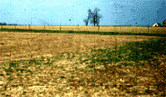
Figure
1. Ice-sheet killing of red clover. Only a few plants survived
where snow had drifted next to a snow fence.
|
Back to Top
Symptoms
|

Figure
2. Root rot of red clover.
|
Clover plants affected by root, crown, and stolon rots are generally
unthrifty, yellowish, stunted, and often wilt during hot, dry weather.
In wet weather seeds may rot. Seedlings sometimes wilt, dry up,
and die (damp-off). Plants may gradually wither and die at any age
or time during the year.
Decayed root, crown, and stolon tissues are mostly corky, spongy,
or soft and light brown, reddish brown, or blackish brown (Figure
2). Affected parts are sometimes covered with a cottony-white growth
(mycelium of Sclerotinia) in which black bodies, called sclerotia,
are later embedded.
Rot may occur on the surface of larger roots, grow up and down
the central core of large roots, or prune away the active feeder
roots. New roots are attacked as rapidly as they replace the older,
decayed roots.
|
Back to Top
Winter Injury
|
Various types of winter injury cause high losses in red clover
stands. Injured plants are further damaged by the entrance of fungi
and bacteria before the injured crown and root tissues have an opportunity
to recover.
There are at least four distinct types of winter injury:
HEAVING. Caused by alternate freezing and thawing, heaving
often severely damages clover stands. Damage occurs most often on
wet, poorly drained land.
LOW TEMPERATURE INJURY. Injury occurs when unadapted varieties
and types are used. Southern clover types that continue active growth
into early winter often suffer from cold injury. In unusually cold,
open winters, even adapted, northern types of clovers may be injured
or killed. Late applications of fertilizer (especially nitrogen)
tend to aggravate the situation.
ICE SHEETS. The most serious winter injury is produced by
ice sheets. Sleet storms of freezing rain can cause ice to form
over wide areas. The result is often complete losses of stands (Figure
1). Ice sheets can also form in low, poorly drained areas where
water from rain or melting snow accumulates. Clover varieties most
resistant to extreme cold are also most resistant to ice-sheet injury.
Other conditions similar to ice sheets, such as waterlogged frozen
soil and heavily packed snow, can also produce winter injury. Farmers
have long known that clovers frequently survive winterkilling better
on rolling, well drained soil than on flat, poorly drained soil.
FROST INJURY. Frosts kills back the tops after plants begin
to grow vigorously in early spring. Affected plants recover rather
quickly. Damage is most severe in low areas where cold air settles.
|
Back to Top
Prolong the general vigor and useful life of clover stands by carrying
out all cultural practices recommended by University of Illinois Agronomists
and your nearest Extension office. Recommended practices include the following:
1. Lime acid soils to attain a pH of 6.2 to 7 (slightly acid to neutral).
2. Practice balanced soil fertility based on a soil test. Avoid excessive
rates of fertilizer, especially nitrogen.
3. Sow high-quality, certified, disease-free seed of well-adapted, high-yield
varieties recommended for your area. These varieties are listed in Illinois
Agricultural Pest Management Handbook. Or plant high-quality, Illinois-grown
medium red clover seed. Avoid seed grown in southern states or foreign
countries.
4. Where practical, keep heavily infected fields out of legumes for three
years or more. Grow grasses, cereals, corn, or sorghum. Plow under thin,
unproductive stands.
5. Control root- and crown-feeding insects. Follow recommendations made
by University of Illinois Extension Entomologists and your nearest Extension
adviser.
6. Do not leave straw from the companion crop above the clover plants.
Either remove it from the field or break it up enough to let the straw
work down through the stubble to the ground.
7. Avoid overgrazing, especially late in the growing season (about September
1 in northern Illinois to October 15 in southern Illinois). Overgrazing
cuts down the food reserves in the taproot and crown that plants need
for development and winter survival.
Back to Top
|


