|
Powdery mildew, caused by the fungus Erysiphe polygoni, occurs
wherever red clover is grown. The disease can attack plants at any
stage of maturity, but it is most prevalent in late summer and early
fall when nights are damp and cool and days are warm and dry. Long
periods of relatively dry summer weather favor its development and
spread; frequent rains discourage it.
Powdery mildew can reduce both yield and quality of forage and hay.
Ordinarily it is of little consequence on the first hay crop, but
is more abundant on the second.
The powdery mildew fungus attacks some 360 different species of
plants in over 150 genera. There are many strains or physiologic
races, each able to attack different genera and species of plants.
Physiologic races differ in their ability to attack clover species
and even varieties within a species.
|
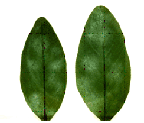
Figure
1. Powdery Mildew of Red Clover
|
Back to Top
Symptoms
Small patches of fine, white to pale gray, cobwebby growth develop on
the upper leaf surface. The patches later enlarge and merge, and the leaf
surface looks as if it has been dusted with white flour (Figure 1). The
fungus may also grow on the lower surface of the leaves and on the stems.
Severe attacks can make entire fields appear white. Infected leaves may
turn yellow and wither prematurely.
The powdery mildew fungus survives the winter on diseased plants as fungus
fruiting bodies (cleistothecia) that appear as black specks.
Ascospores are produced within asci in the cleistothecia and provide
primary inoculum. The ascospores are released when the cleistothecia and
asci split open and are blown to leaves. Infections can occur at any time
during the growing season, but are most common from midsummer to early
fall. Conidia, produced in chains on the cobwebby growth, are formed in
great numbers and provide the main source of secondary inoculum. Cleistothecia
are formed again in the autumn to complete the cycle. The microscopic
ascospores and conidia are blown from plant to plant by air currents.
1. When feasible, plant adapted red clover varieties that are resistant
to powdery mildew. For currently recommended varieties refer to Illinois
Agricultural Pest Management Handbook which is available at your nearest
Extension office or at ITCS, University of Illinois P345, 1917 S. Wright
St., Champaign, IL 61820.
2. Practice balanced fertility based on soil test recommendations.
3. Harvest on a timely schedule, especially after the first cutting.
4. Clean all harvesting equipment before the first harvest and when going
from field to field.
5. Control weeds and insects following recommendations of University
of Illinois Extension Weed Specialists and Entomologists. Controlling
weeds and insects helps to reduce stresses on plants
Back to Top
|


