Reports on Plant Diseases |
| RPD No. 901
- Fusarium Yellows of Cabbafe and Related Crops
|
September 1988
|
[ Symptoms
] [ Disease Cycle ] [ Control
]
Fusarium yellows is a warm-weather disease
caused by the soilborne fungus Fusarium oxysporum
f. sp. conglutinans. Five strains or races of
the fungus are known and described: Strain 1 infects cabbage, Brussels
sprout, cauliflower, collard, and kale; strain 2 attacks radish; strains
3 and 4 are found on flowering stock; and strain 5 is found on cabbage.
The fungus is closely related to, but distinct from, fungi causing Fusarium
wilts of melons, peas, pepper, potato, sweet potato, tomato, carnation,
China aster, gladiolus, cotton, and numerous other plants. The disease
is common on cabbage in home gardens throughout the Midwest but is of
lessening importance to commercial growers, because most of them now plant
highly resistant varieties. In thoroughly infested soils, susceptible
cabbage and radish varieties may be completely destroyed.
Many crucifers, or members of the cabbage family, are
susceptible to Fusarium yellows or wilt. They include cabbage, broccoli,
Brussels sprout, cauliflower, Chinese cabbage, collard, kale, kohlrabi,
mustards, radishes, rape, rutabaga, seakale, turnips, and watercress.
Back to Top
SYMPTOMS
Since cabbage is the most commonly affected crucifer
in Illinois, the symptoms of yellows on this crop are the ones described
here. The symptoms on related crucifer plants are similar. The first and
most apparent symptom is a dull green to yellowish green color of the
leaves of plants in the seedbed or in the field within a month after transplanting.
Young plants may be stunted, turn yellow, and die rapidly in warm soils.
The lower leaves develop a one-sided warping or curling (Figure 1), with
the yellow color being more intense on one side of the leaf midrib than
on the other. The stem may be twisted toward one side. Yellowing, browning,
and withering of the leaves progresses up the plant.
Affected leaves drop prematurely (Figure 2), and growth
is retarded. Very susceptible plants may die within a few weeks, while
others in the same field or garden may live for a month or more. Some
even survive the season, but head imperfectly. Resistant plants, or susceptible
plants growing in cool soil, may show symptoms on the lowest leaves but
produce normal heads. Early varieties planted early may escape the disease
until they approach maturity. A yellow to dark brown discoloration can
be seen in the water-conducting vessels (xylem) in the stem, petioles,
and veins of the leaves when they are cut through. Fusarium yellows is
often confused with black rot, a bacterial disease in which the vascular
bundles and the smaller veins in diseased leaves are black, while those
affected by Fusarium yellows are yellow to brown. On radish, symptoms
include a yellowing of the lower leaves starting on one side of the plant.
Later, all the leaves turn yellow and fall prematurely, leaving a bare
stem.
Back to Top
|
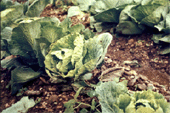
Figure 1. Partially
grown cabbage plant showing distortion of the lower leaves caused by Fusarium
yellows.
.
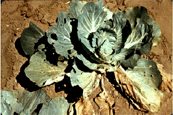
Figure 2.
Leaves affected by Fusarium yellows dropping away from plant
|
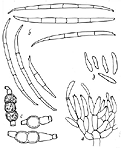
Figure
3. Fusarium oxysporum, the fungus that causes Fusarium yellows
of cabbage and unrelated plants, as it would be seen under a highpower
laboratory microscope: (a) conidiophores, many bearing macroconidia;
(b) macroconidia; (c) microconidia; (d) thick-walled chlamydospores
(drawing by L. Gray)
|
The Fusarium fungus survives
and may actually increase in a number of soil types for many years, independent
of any host plants. This ability to survive eliminates any normal rotation
program or general sanitation as an effective control measure. Fusarium
yellows is, however, almost completely checked when the average soil temperature
is below 61°F (16°C). The appearance and severity of the disease
are increased when air and soil temperature averages rise above this point.
The fungus grows most rapidly and the disease is most severe at temperatures
from 80° to 85°F (26° to 29°C). Growth is inhibited at
90° to 95°F (32° to 35°C). Soil moisture and soil reaction
(pH) have little effect on Fusarium yellows. However, soil nutrient status
can critically affect symptoms expression; potassium deficiency leads
to a much intensified syndrome.
The Fusarium fungus invades
the plant through the young rootlets or wounds in the older roots at transplanting
time or later. The fungus then moves directly to the water-conducting
tissues (xylem) and then progresses up the stem into the leaves. The fungus
colonizes the xylem tissues and does not invade other tissues until part
or all of the plant dies. The fungus then produces its spores both inside
and outside affected stems (Figure 3).
Dissemination of the fungus takes place from seedbed
to field or from one field or garden to another by infected ransplants,
infested soil clinging to transplants, farm equipment, plant refuse, animals,
surface-drainage water, and wind. Occasionally, the yellows fungus is
carried long distances in seeds.
The Fusarium fungus produces
three kinds of microscopic spores: small, colorless, one-celled, oval
to elliptical icroconidia; large, slightly curved, septate macroconidia;
and rounded, thick-walled chlamydospores (Figure 3) that can survive long
periods in the soil being resistant to unfavorable environmental conditions.
|
Back to Top
- Once the Fusarium yellow fungus is present in a field or garden,
the only successful control in cabbage is to grow yellows-resistant
varieties. There are two types of resistance, A and B. Cabbage varieties
with type A are uniformly resistant regardless of the soil temperature.
Varieties with type B show a relatively high degree of resistance when
average soil temperatures are below 70°F (21°C) and when grown
at optimum soil fertility levels. As the soil temperature increases,
type B resistance breaks down. At about 77°F (25°C) or above,
type B-resistant plants become infected and killed while type A-resistant
plants remain unaffected. Type B resistance is found principally in
the older, late-maturing cabbage varieties such as ‘Bugner’,
‘Red Hollander’, ‘Resistant Flat Dutch’, ‘Wisconsin
All Seasons’, and ‘Wisconsin Hollander’. Most of the
modern Fusarium-resistant cabbage varieties carry type A resistance.
For information on recommended varieties for Illinois read Illinois
Extension Circular 1331, Vegetable Gardening in the Midwest, and Circular
1373, Midwest Vegetable Production Guide for Commercial Growers, available
from Information Technology and Communication Services, University of
Illinois, P345, 1917 S. Wright St., Champaign, IL 61820.
- Radish yellows is also effectively controlled through the use of
resistant varieties. Refer to the publications listed above for recommended
varieties. Radish usually escapes infection if planted in early spring
or in the fall when soil temperatures are low.
- Most varieties of broccoli, Brussels sprout, and cauliflower have
a high degree of natural resistance to yellows except in hot, dry seasons.
Kale, kohlrabi, and collard are generally very susceptible while Siberian
kale is resistant.
- Susceptible crucifers should not be planted in areas that are likely
to receive surface-drainage water from infested fields.
- Grow transplants in soil that has been disinfested by steam or a
soil fumigant.
- Rotate the field or garden to nonhost crops such as lettuce, peppers,
or tomatoes for several years to prevent buildup for the Fusarium
fungus in the soil.
- In fields and gardens where the disease has not appeared, extreme
caution is needed to exclude infected crucifer transplants. Purchase
only certified, disease-free seed or transplants of resistant varieties.
Keep the fungus out of yellows-free fields and gardens by preventing
the spread of infested soil carried on equipment, tools, feet, and running
water. Do not put crop debris in compost or manure piles.
|
Information concerning insecticides, weed control, varieties, and other recommendations
can be found in the Illinois Homeowners' Guide to Pest Management, available
at your nearest Extension office.
Back to Top
|


